
The Gate That Can Hide the City
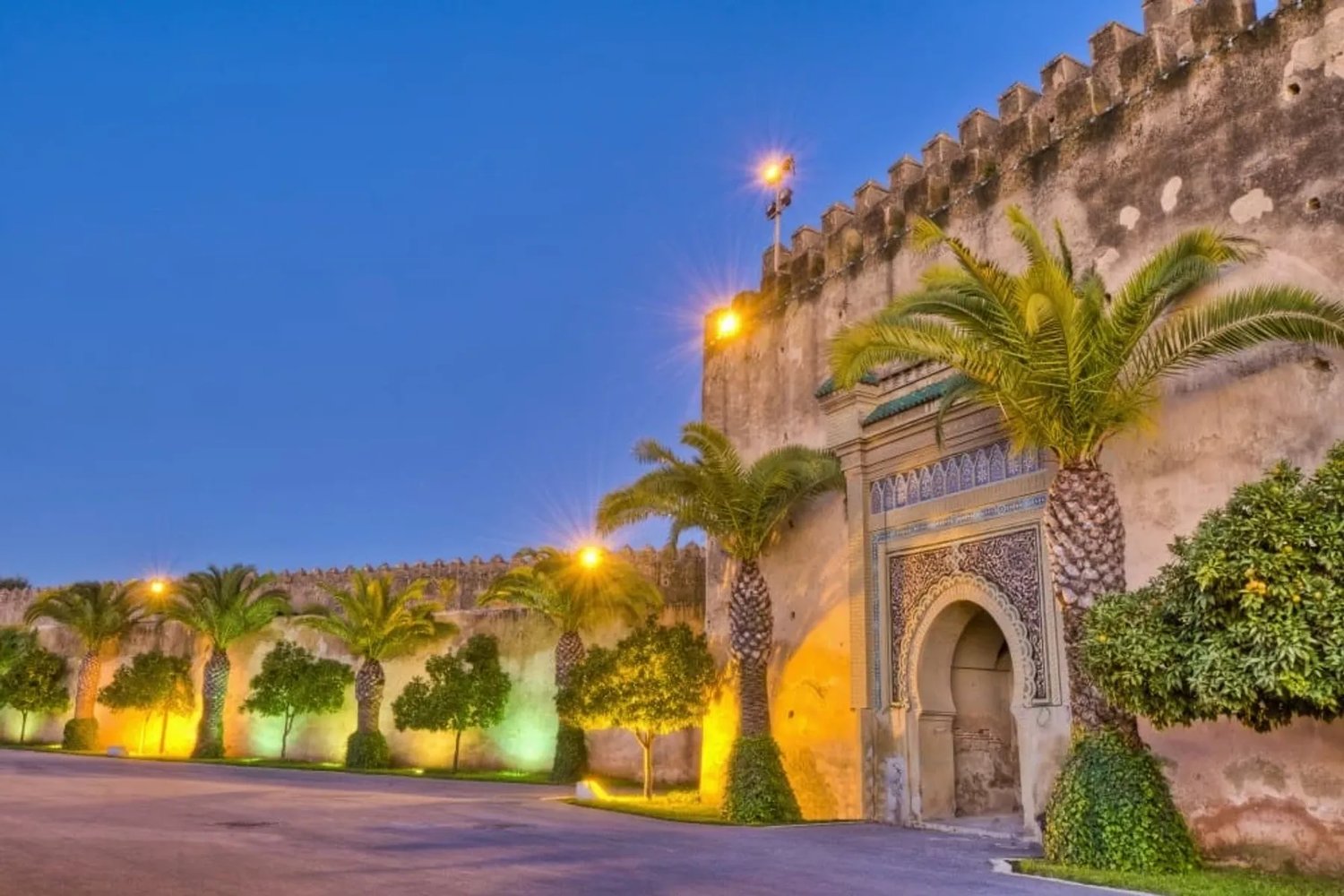
Bab Mansour is one of Morocco’s most recognisable monumental gates. Facing Place El Hedim, its scale, zellige, carved stone and calligraphic decoration announce the imperial ambition of Meknès before a visitor has taken a single step beyond it. Yet the fame of the gate can also reduce the city to one magnificent façade.
Meknès is not simply Bab Mansour, nor is it only the surviving project of one powerful sultan. It is an older medina, an imperial capital, a landscape of walls and reservoirs, a city of religious learning, domestic architecture, craftsmanship, music and daily neighbourhood life. To understand Meknès, the gate must be treated as an entrance rather than a conclusion.
Before the Imperial Capital
Meknès did not begin with Moulay Ismail. Its history reaches back to the medieval period, when the Almoravids established a military settlement here during the eleventh century. The city later developed under the Almohads and Marinids, long before it became an imperial capital.
This earlier history remains essential because the medina and imperial city represent different stages in Meknès’s development.
Within the older urban fabric, mosques, markets, neighbourhoods and educational institutions reflect centuries of religious, commercial and domestic life. The Marinid Bou Inania Madrasa, built during the fourteenth century, is one of the clearest reminders that Meknès already possessed architectural refinement and scholarly importance before the rise of its great royal complex.
Moulay Ismail did not create the city from nothing. He transformed an existing urban centre and placed a new imperial world beside it.
Moulay Ismail’s Monumental Project
When the Alawite sultan Moulay Ismail made Meknès his capital in the late seventeenth century, he began one of the most ambitious royal building programmes in Moroccan history.
Palaces, gardens, reservoirs, ceremonial spaces, warehouses, stables, walls and monumental gates formed an enormous imperial precinct adjacent to the medina. Architecture was used not only for residence and defence, but also to communicate authority, order and the permanence of royal power.
The result was not one palace in the conventional sense. It was an extensive royal city composed of several interconnected enclosures and specialised spaces.
Some areas were designed for ceremony and administration. Others supported horses, food storage, water supply, gardens and the practical demands of a large court. The surviving structures reveal how closely architecture and state organisation were connected.
Meknès therefore deserves to be read at two scales: through the beauty of individual monuments and through the larger system they once formed.
Bab Mansour as a Threshold
Bab Mansour was commissioned during the reign of Moulay Ismail and completed under his son Moulay Abdallah in 1732. Its importance lies not only in its decoration, but also in its position. The gate faces Place El Hedim and marks the transition between public urban life and the monumental world of the imperial precincts.
This makes the square and gate inseparable. Place El Hedim has long functioned as a zone of movement, trade, gathering and performance, while Bab Mansour represents controlled access, ceremony and power.
One side belongs to the rhythm of the city. The other announces the authority of the court. Standing here, a visitor is not simply looking at an isolated monument. The square reveals the relationship between medina, royal city and public space. It is one of the best places in Meknès to understand how architecture can organise movement and social hierarchy. But the most important experience begins after turning away from the photograph everyone takes.
The Imperial City Beyond the Façade
Behind and around Bab Mansour, the surviving imperial landscape unfolds through courtyards, walls, gateways and broad open spaces. Lalla Aouda Square formed part of the ceremonial environment near the royal complex. Nearby, the Koubbat as-Sufara, often described as the Pavilion of the Ambassadors, reflects the diplomatic and administrative functions of the court. It was a place associated with the reception of envoys and the performance of royal authority.
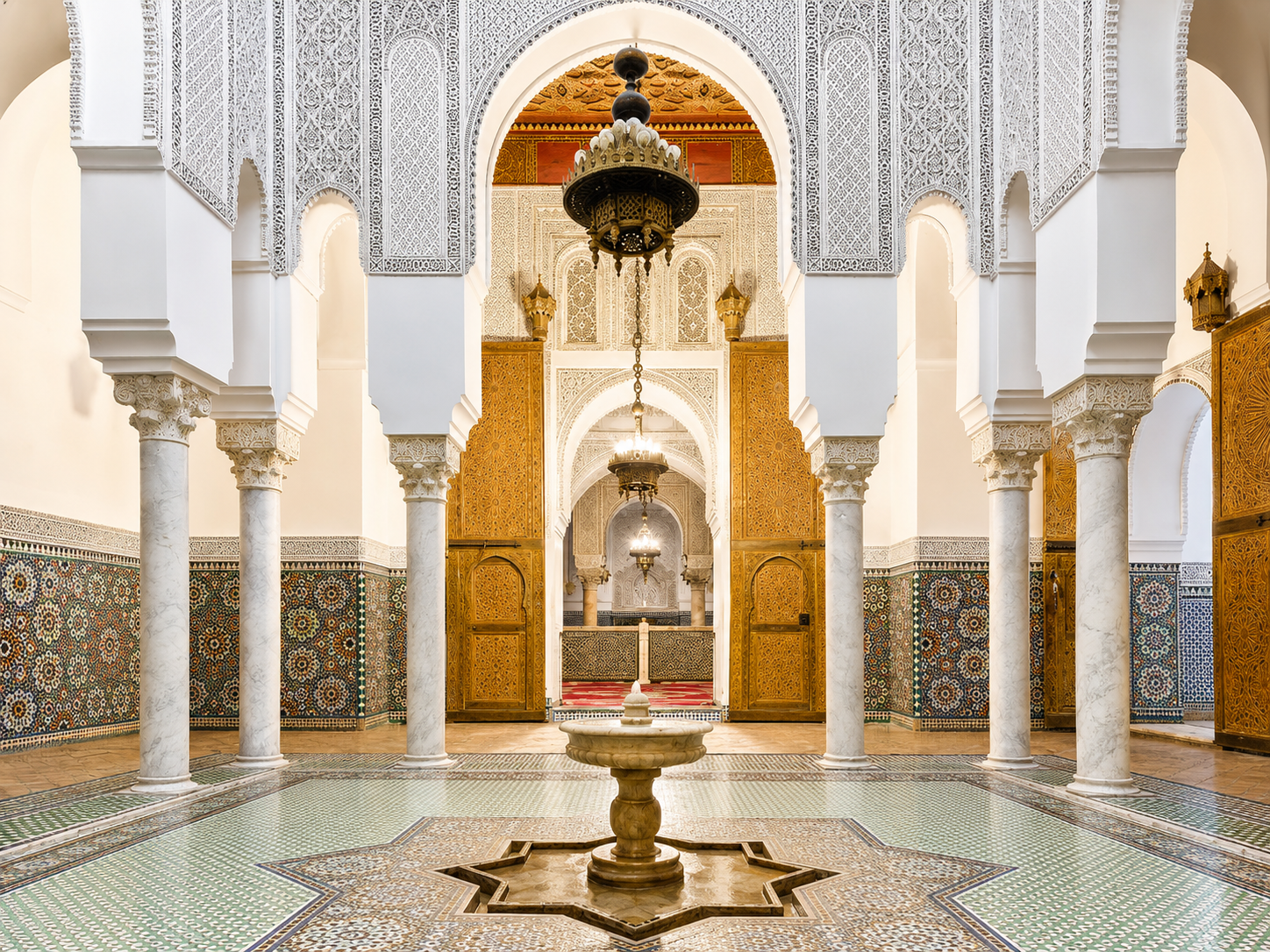
The Mausoleum of Moulay Ismail presents a different atmosphere. Instead of overwhelming scale, it uses sequences of courtyards, decorated interiors and controlled transitions to create solemnity and focus.
Together, these spaces show that the imperial city was not designed around one architectural language. Monumentality, privacy, ceremony, devotion and administration each required a different spatial response.
The strength of Meknès lies in these contrasts: immense walls beside intimate courtyards, broad ceremonial spaces beside narrow passages, restrained exteriors beside richly worked interiors.
Water, Storage and the Architecture of Power
The Heri es-Souani and Dar al-Ma complex reveals a less decorative but equally important side of Moulay Ismail’s capital. Royal power depended on infrastructure. Dar al-Ma contained well rooms and a system of underground channels connected to the water supply of the imperial city. Beside it, the structures commonly associated with the granaries and royal stables demonstrate the scale of planning required to support the court, its horses and its food reserves.
The repeated arches create one of the most dramatic surviving interiors in Meknès. Their strength comes from rhythm, proportion and engineering rather than surface decoration. Nearby, Sahrij Souani formed part of the same hydraulic landscape. This vast reservoir stored water for the palaces, gardens and other needs of the imperial complex.
These structures change the way the city should be understood. Meknès was not built only to impress. It was designed to function as a capital capable of sustaining people, animals, gardens, administration and defence. Water management, storage and logistics were therefore as central to the imperial project as monumental gates.
The Medina Has Its Own Story
Visitors who concentrate only on the royal monuments risk overlooking the older medina, where the city’s everyday life developed over centuries. Its streets contain mosques, neighbourhood markets, workshops, traditional houses, fountains and small commercial spaces. Unlike the imperial precincts, the medina was shaped through repeated use, adaptation and the needs of residents, traders, religious institutions and craftspeople.
The Bou Inania Madrasa offers one of the richest architectural encounters within this older fabric. Its zellige, carved plaster, calligraphy and cedar wood reflect the artistic language of Marinid religious architecture. The former student rooms and inward-facing courtyard connect beauty with learning and disciplined communal life.
The medina also rewards attention to smaller elements: the depth of a doorway, the bend of a lane, a carved wooden screen, a neighbourhood mosque or the relationship between a market and the houses around it.
These details prevent Meknès from becoming a story only about rulers. They return the city to the people who lived, studied, traded, worshipped and worked within it.
Dar Jamai and the Culture of the Interior
At the edge of Place El Hedim stands Dar Jamai, a nineteenth-century palace built as a private residence for a prominent ministerial family. Its architecture provides another important layer in the history of Meknès. The building belongs neither to the medieval city nor to Moulay Ismail’s original imperial programme. It reflects the refined domestic culture of a later Moroccan elite.
Courtyards, painted wood, carved plaster, zellige and an Andalusian-style garden create an interior world organised around reception, family life and controlled beauty. Today, Dar Jamai houses the National Museum of Music. Its collections connect the palace to Morocco’s diverse musical traditions, instruments and performance cultures.
This transformation is meaningful. A residence associated with elite urban life has become a public institution devoted to collective cultural memory. Dar Jamai demonstrates that heritage can acquire new functions without losing the architectural character that gives it significance.
Gates, Walls and the Shape of Movement
Meknès is a city of walls, but its gates reveal that walls were never simply barriers. Bab el-Khemis, Bab Berdaine and other entrances connected different parts of the city with roads, markets, neighbourhoods and surrounding agricultural areas. Each gate had its own position within systems of movement and economic life. Their scale also shaped the experience of arrival. Passing through a monumental gate changed the relationship between exterior and interior, open landscape and dense urban space, ordinary travel and controlled entry.
The walls of Meknès therefore help explain the city’s geography. They separated functions, protected royal and residential zones, channelled movement and gave architectural form to political boundaries.
Today, fragments of these extensive fortifications still allow visitors to read the city as a sequence of connected enclosures rather than a single compact medina. Bab Mansour may be the most celebrated gate, but it belongs to a much larger architectural language.
Craftsmanship Beyond Decoration
Meknès continues to be associated with woodwork, weaving, embroidery, leatherwork, ceramics, metalwork and damascened iron. These crafts matter because they connect monuments with living practice. Zellige, carved wood and metal decoration are not anonymous surfaces. They are the result of specialised knowledge, tools, measurements and techniques learned through training and repetition.
Damascening is especially associated with Meknès. Fine metal designs are inlaid into darker metal surfaces to create objects that combine precision with ornament. The practice can be seen in jewellery, plates, decorative objects and other pieces produced by local artisans.
Craftsmanship also reveals how a historic city continues to change. Artisans work within inherited traditions, but they also respond to new markets, materials and forms of design. The survival of a craft is therefore not the repetition of an unchanged past. It depends on whether knowledge remains useful, teachable and economically viable in the present.
A City Connected to a Wider Landscape
Meknès cannot be separated from the fertile plains and historic settlements around it. The nearby Zerhoun region, the town of Moulay Idriss Zerhoun and the archaeological site of Volubilis place the city within a much longer landscape of settlement, agriculture, pilgrimage and exchange.
Volubilis preserves evidence of ancient Mauritanian and Roman urban life. Moulay Idriss Zerhoun carries profound religious and historical importance in the formation of early Islamic Morocco. Meknès later emerged as an imperial centre within this already significant region. These places should not be treated as interchangeable attractions. Each belongs to a different period and cultural context.
Together, however, they demonstrate why the Meknès region is so important. Within a relatively compact area, visitors can encounter ancient archaeology, sacred history, medieval urban development, Alawite imperial ambition and continuing rural traditions. The city becomes richer when viewed as part of this wider historical geography.
Why Meknès Deserves More Time
Meknès is sometimes visited quickly, reduced to Bab Mansour, Place El Hedim and a short excursion before moving elsewhere. That approach misses the structure of the city.
Its meaning lies in the relationship between the older medina and the imperial precincts; between ceremony and infrastructure; between monumental walls and domestic interiors; between royal history and living craftsmanship.
A longer visit allows these relationships to become visible. The Heri es-Souani complex makes Bab Mansour’s grandeur more understandable. The Bou Inania Madrasa places the city’s imperial chapter within an older history. Dar Jamai extends the story into the nineteenth century and the present. The markets and workshops reveal that heritage continues through work and daily life. Bab Mansour deserves its fame. But Meknès becomes memorable only when the visitor moves beyond it.
Continue the Journey
Explore the Meknès destination page for an introduction to the city’s identity, principal landmarks and surrounding region. For a complete visual journey through its medina, imperial monuments, architecture, local culture, nearby highlights and practical travel context, continue with the Exotic Morocco Premium Visual City Guide.